Cognitive Stimulation Activities That Enhance Dementia Care
Cognitive Stimulation Activities That Enhance Dementia Care: Effective Memory and Engagement Programs for Alzheimer's and Dementia Patients
Cognitive stimulation activities are structured, meaningful tasks designed to engage thinking, memory, language, and social interaction for people living with dementia and Alzheimer's disease. These activities work by activating neural networks through repetition, novelty, and emotionally salient cues, which support cognitive reserve and help maintain daily functioning and mood. Readers will learn what cognitive stimulation therapy (CST) entails, which activities have the strongest evidence base, how programs can be tailored by stage of dementia, and practical steps families can use at home. Many caregivers seek non-pharmacological approaches to reduce agitation, preserve abilities, and improve quality of life; this article shows how targeted activities deliver those outcomes. The guide also explains how specialized memory care environments support consistent delivery of CST and where families can find assessment and program support. Topics covered include definitions and mechanisms, top activity categories, measurable benefits backed by recent research, individualized program workflows, caregiver strategies, and common questions clinicians and families ask.
What Are Cognitive Stimulation Activities and Why Are They Important for Dementia Care?
Cognitive stimulation activities are intentional, structured interventions that use conversation, themed tasks, reminiscence, and sensory prompts to strengthen mental abilities and social engagement. They operate by exercising attention, recall, language, and problem-solving pathways, which can slow decline and improve day-to-day functioning and emotional well-being. Because pharmacological treatments have limited effects on many cognitive domains, these non-pharmacological therapies play a central role in comprehensive dementia care. Understanding the core mechanisms clarifies why activity choice, frequency, and personalization matter for measurable outcomes like mood, agitation, and participation.
Cognitive Stimulation Therapy (CST) is a manualized, evidence-based approach that typically runs in small groups with themed sessions focused on orientation, word games, and discussion prompts. Group CST leverages social interaction to amplify cognitive challenge and motivation, while individualized CST adapts materials and pacing to a resident’s history and abilities. Recent meta-analyses report small but meaningful cognitive gains and improvements in quality of life following regular CST, particularly when sessions occur multiple times per week. These clinical outcomes are why many care teams pair CST with sensory and physical activities to create a multimodal program that supports both cognition and mood.
Cognitive Stimulation Therapy (CST) for Dementia Care
Cognitive Stimulation Therapy (CST) groups can be beneficial in improving cognition and quality of life for people with dementia. The aim of the current study is to develop and evaluate a home-based individual Cognitive Stimulation Therapy (iCST) programme for people with dementia which can be delivered by their family carer.
Cognitive stimulation therapy, E Aguirre, 2020
CST and related activities improve memory, mood, and social interaction through repetition, emotional salience, and supportive scaffolding from trained staff. Repetition strengthens retrieval pathways, while emotional cues (music, photos) increase encoding and recall; social exchange reinforces communication and reduces isolation. For families and care teams, this means selecting activities that combine cognitive challenge with personal meaning increases engagement and outcome consistency. The next section describes the specific activity categories that produce the most consistent benefits for people with dementia.
Caring for people with dementia requires stage-appropriate adaptation: what challenges someone with early-stage disease may enjoy will overwhelm someone with advanced impairment. Early-stage residents often benefit from problem-solving and novelty, moderate-stage participants do best with guided, familiar tasks, and severe-stage individuals respond most to sensory, reminiscence, and comfort-focused interventions. Recognizing these stage differences allows care teams and families to match activities to capacity, preserving dignity and maximizing participation. This leads into a deeper look at specific activity types and how they support cognition and emotional health.
Key benefits of cognitive stimulation activities: Cognitive maintenance: Regular engagement supports memory and executive function through targeted practice. Emotional regulation: Meaningful activities reduce agitation and improve mood by providing structure and pleasure. Social connection: Group-based formats and family involvement reduce isolation and encourage communication.
These benefits explain why non-pharmacological approaches are essential components of dementia care and motivate targeted program design in specialized memory care settings.
Which Cognitive Stimulation Activities Are Most Effective for Dementia and Alzheimer's Patients?

Cognitive stimulation activities cluster into several evidence-backed categories—music, art, brain games, physical exercise, reminiscence/sensory work, and social or pet-based interactions—each offering different cognitive and emotional benefits. Selecting activities that align with the resident’s history, sensory profile, and stage of dementia increases success while minimizing frustration and dropout. Below are the major activity types with concise descriptions of how each supports cognitive health and social engagement.
Music therapy enhances mood, memory recall, and nonverbal communication by engaging auditory memory pathways and emotional networks that often remain robust in dementia. Familiar songs can trigger autobiographical memories and spontaneous speech, reduce agitation during care tasks, and support rhythmic activities that aid motor coordination. Both group sing-alongs and individualized playlists produce measurable calming effects and improved participation when matched to personal preferences. Using music as a prompt also sets the stage for reminiscence and conversation activities that further stimulate cognitive processing.
Research indicates that music-based interventions can be particularly effective for evoking autobiographical memories and serving as a non-pharmacological treatment for Alzheimer's disease.
Music Therapy for Alzheimer's Disease and Memory Evoked by Music
Finally, we estimate that interventions based on the paradigm of autobiographical memories evoked by music (MEAMs) could be a good non-pharmacological treatment alternative for people with Alzheimer's disease.
Music therapy as non-pharmacological treatment in Alzheimer's disease—effects on memory—systematic review, 2024
Art and creative activities provide channels for self-expression and sensory engagement when verbal skills decline, using simple materials like paints, collage, or clay to tap into procedural memory and fine motor planning. Art tasks scaffold participation by adjusting complexity, offering choices, and focusing on process rather than product to reduce performance anxiety. These activities build confidence, support identity, and often improve mood through achievement and sensory pleasure. Staff facilitation that emphasizes encouragement and descriptive feedback enhances both cognitive and emotional outcomes.
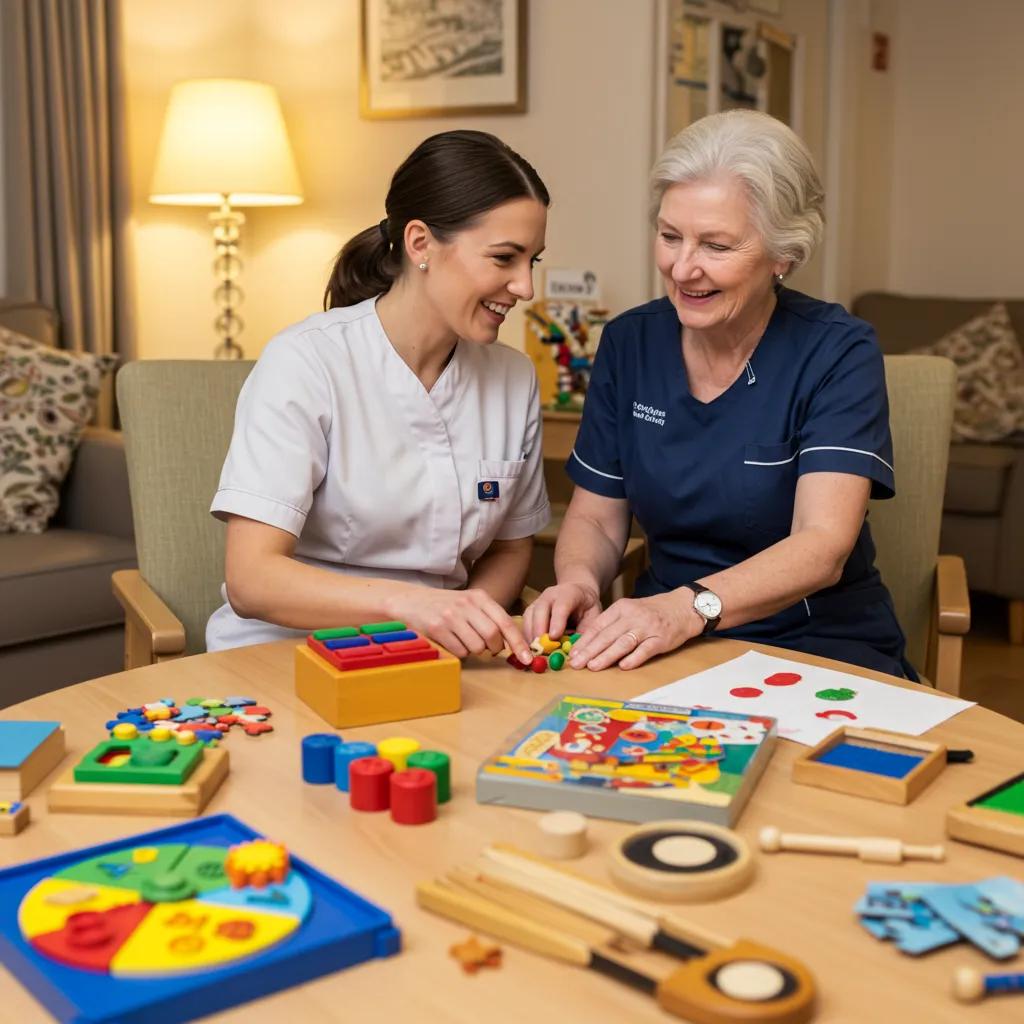
Brain games and puzzles exercise attention, sequencing, and problem-solving through graded tasks such as matching games, simple crosswords, jigsaws, and card games that can be adapted for difficulty. These tasks support cognitive reserve by repeatedly engaging neural circuits involved in memory and executive function. Structured facilitation—offering prompts, breaking tasks into steps, and providing immediate positive reinforcement—keeps activities attainable and rewarding. Rotating tasks and introducing mild novelty sustain interest and avoid habituation.
Physical activities like walking groups, chair-based exercises, and tai chi improve cardiovascular health, balance, sleep, and mood, all of which indirectly support cognition. Exercise increases cerebral blood flow and may promote neuroplasticity, while group formats add social stimulation and routine. Low-impact, consistent programs tailored to mobility levels help reduce anxiety and support daily functioning. Integrating movement with cognitive prompts (e.g., memory cues during walks) compounds benefits for both body and mind.
Reminiscence and sensory therapies use life-story work, memory boxes, familiar scents, and tactile objects to evoke personal memories and provide comfort. Sensory kits that include fabric swatches, household items, and photos help staff elicit narratives, reduce distress, and anchor identity. These therapies are particularly effective when staff use open-ended prompts and family-provided materials to connect sessions to the resident’s past. Sensory approaches are also invaluable for severe-stage dementia, where verbal recall is limited but emotional memory remains accessible.
Social engagement—including pet therapy and small-group activities—reduces isolation, encourages communication, and provides structure that supports behavior regulation. Animal visits and supervised interactions often increase engagement levels and provide calming, nonjudgmental companionship. Group celebrations, themed events, and family-inclusive activities foster belonging and reinforce the meaning of participation. Together, these categories create a balanced activity program that targets cognitive, emotional, and physical domains.
Intro to comparison table: The table below helps families and care teams compare activities by their primary cognitive targets, emotional benefits, and typical stage suitability.
ActivityPrimary Cognitive BenefitEmotional/Social BenefitSuitable Dementia StagesMusic therapyLong-term autobiographical recall; attentionMood stabilization; decreased agitationEarly–SevereArt & craftsProcedural memory; fine motor planningSelf-expression, pride, and identityEarly–ModerateBrain games & puzzlesWorking memory; sequencingSense of achievement; social playEarly–ModeratePhysical exerciseExecutive function via blood flowReduced anxiety; improved sleepEarly–ModerateReminiscence & sensoryAutobiographical memory triggersComfort; emotional connectionModerate–SeverePet therapy & groupsSocial cognition; attentionCompanionship; reduced isolationAll stages
How Does Braley Care Homes Implement Individualized Cognitive Stimulation Programs?

Braley Care Homes applies individualized cognitive stimulation by combining detailed social histories, structured assessments, and staff-led activity planning that prioritizes resident preferences and safety. The facility’s approach integrates evidence-based CST principles with a home-like environment and specialized staff roles to create consistent, meaningful engagement for residents. Assessment-driven planning ensures each resident’s program balances cognitive challenge with comfort, and regular review cycles monitor outcomes and adapt activities.
Program ElementHow It's DeliveredBenefit / OutcomeIntake & social historyFamily interviews and resident life-story collectionPersonalized activity selection; higher engagementIndividualized activity plansWeekly schedules with trial sessions and adjustmentsImproved participation; measurable progressStaff training & clinical oversightOngoing dementia-focused education led by clinical staffConsistent facilitation and behavior managementPurpose-built spacesSecure zones, activity rooms, and an outdoor courtyardSafe walking groups; outdoor sensory stimulation
This mapping shows how operational components translate to resident outcomes by connecting assessment, staff skill, and environment to activity success. Regular documentation and family feedback close the loop so programs evolve with changing needs.
Staff are trained in dementia-focused facilitation techniques, and clinical oversight guides program fidelity and outcome measurement. Roles include licensed clinical leadership for program design and nursing staff to monitor health-related barriers to participation. Training emphasizes scaffolding, clear prompts, de-escalation, and using personal history to increase relevance. Ongoing coaching helps staff adapt materials and pacing to each resident’s response, promoting consistent delivery across shifts.
Facility features support safe and meaningful activities through design elements like secure outdoor courtyards, multiple activity zones, and quiet spaces for one-to-one sessions. These spaces allow simultaneous group programming and quieter sensory work without cross-stimulation. Secure outdoor areas enable walking groups that combine physical activity with cognitive prompts, while multi-zone layouts let staff tailor noise, lighting, and seating to individual sensitivities. Together, assessment-driven planning, trained staff, and purpose-designed spaces create a reliable pathway from evaluation to engagement and outcome tracking.
What Are the Measurable Benefits of Cognitive Stimulation Activities for Dementia Patients?
Cognitive stimulation activities produce measurable benefits, including small improvements in cognitive testing scores, consistent enhancement in quality of life measures, reductions in agitation, and higher engagement rates during daily routines. Recent research summaries indicate small but statistically significant cognitive gains from structured CST programs and stronger effects on mood and social functioning. Practical outcome measures used in care settings include engagement scales, mood/anxiety ratings, and activity participation logs.
Cognitive activities improve quality of life and reduce anxiety by providing structured opportunities for mastery, social contact, and sensory comfort that address unmet emotional needs. For example, music interventions commonly produce immediate reductions in agitation and observable increases in positive facial expressions and social interaction. In care settings, staff note improved sleep patterns, fewer care refusals, and smoother mealtime routines following consistent activity engagement. These real-world observations align with trial data showing enhanced well-being after sustained programming.
Scientific research supports the use of music, art, and brain games in dementia care through randomized trials and meta-analyses that report cognitive maintenance and mood improvements. Current studies indicate that group CST yields modest cognitive score improvements and that music and art produce more robust effects on mood and behavior. While effect sizes vary by study, the convergence of evidence supports multimodal programming rather than single interventions. Ongoing study designs increasingly emphasize personalized, mixed-approach programs that mirror clinical practice.
Physical exercise contributes to cognitive preservation and mood enhancement via improved cardiovascular health, increased neurovascular coupling, and promotion of neuroplasticity. Exercise programs in seniors show benefits for executive function, balance, and depression symptoms; combined with cognitive tasks, exercise can amplify cognitive engagement. Social and sensory activities reduce isolation and depression by restoring roles, providing shared experiences, and delivering calming sensory input. Measurable outcomes often include reduced loneliness scores and fewer behavioral incidents, reinforcing the value of integrated activity models in dementia care.
Outcome measures commonly tracked in programs: Cognition: Brief standardized tests or function-focused cognitive screens. Mood/Behavior: Agitation scales and depression screens. Engagement: Participation logs and observational engagement scales.
These metrics help teams iterate on program design and demonstrate tangible benefits to families and care partners.
How Can Families and Caregivers Support Cognitive Stimulation at Home?
Families and caregivers can support cognitive stimulation by using short, meaningful activities that fit daily routines and the resident’s interests, focusing on repetition, sensory cues, and positive reinforcement. Simple home-based strategies—music playlists, photo albums, adapted games, and guided reminiscence—provide frequent cognitive "practice" that complements facility programs. Consistency, brief sessions, and adapting tasks to ability level increase success and reduce frustration.
Practical activities families can use immediately include music sessions, memory boxes, simple cooking tasks, and short matching or sorting games that use familiar objects. These low-effort, high-impact activities require minimal materials and can be woven into dressing, mealtime, or grooming routines to boost engagement without adding caregiver burden. Rotating activities and using choice-based prompts keep the resident involved and preserve autonomy.
The development of home-based individual cognitive stimulation therapy (iCST) aims to make these beneficial psychological therapies more accessible to individuals with dementia who may not be able to attend group sessions.
Home-Based Individual Cognitive Stimulation Therapy (iCST)
The UK Department of Health has recently stressed that improving access to psychological therapies is a national priority, but many people with dementia are unable to access psychological interventions. The development of a home-based individual version of CST will provide an easy to use, widely available therapy package that will be evaluated for effectiveness and cost-effectiveness in a multi centre RCT.
Individual Cognitive Stimulation Therapy for dementia (iCST): study protocol for a randomized controlled trial, M Orrell, 2012
Home activity ideas families can implement: Personalized music playlist: Use familiar songs during dressing or relaxation. Memory box: Assemble photos and objects tied to meaningful life events for reminiscence. Simple folding/cooking tasks: Shared, guided tasks that promote sequencing and purpose. Sorting and matching games: Use household items for short cognitive challenges. Short walks or chair exercises: Pair movement with conversational prompts.
ActivityMaterials NeededAdaptation for Stage (Early / Moderate / Severe)Music playlistPhone or player, headphones or speakerEarly: sing-alongs; Moderate: passive listening with prompts; Severe: calming familiar songsMemory boxPhotos, small mementosEarly: narrative prompts; Moderate: guided touching and naming; Severe: sensory-focused itemsSimple gamesCards, large-piece puzzlesEarly: challenging puzzles; Moderate: simplified matching; Severe: tactile sortingCooking tasksUtensils, simple recipesEarly: recipe following; Moderate: stirring/arranging; Severe: sensory involvement (smelling, tasting)
This table helps caregivers choose materials and adjust expectations by stage, making home activities more effective and less stressful.
Braley Care Homes supports families through education, collaborative care planning, and a Free Assessment that helps identify meaningful activities and next steps. Families can request guidance on activity selection, learn facilitation techniques, and coordinate home-to-facility strategies that maintain continuity of identity and engagement. Contacting Braley Care Homes in Hurricane, WV to schedule a Free Assessment connects families with clinical staff who can recommend tailored activities and explain how to reinforce them at home.
What Are Common Questions About Cognitive Stimulation Therapy and Dementia Activities?
Common questions focus on which activities work best at each stage, how to stimulate someone with severe dementia, and what types of CST exist; clear, concise answers help caregivers choose actions that produce results. Short, practical responses reduce confusion and provide immediate steps families and care teams can apply when planning engagement. Below are direct answers to common queries that often appear during care planning discussions.
What are the best cognitive stimulation activities for early-stage dementia?
Early-stage activities should emphasize novelty and cognitive challenge while remaining enjoyable to sustain participation. Examples include learning new skills, structured book or discussion clubs, crosswords, card games, and volunteer-type roles that provide purpose. The goal is to challenge attention and memory without creating anxiety, and to combine cognitive tasks with social interaction for added motivation. These activities preserve skills and create meaningful daily structure that supports identity.
How do you stimulate a person with severe dementia?
For severe dementia, prioritize sensory, comfort-oriented approaches that rely on emotional memory rather than complex tasks. Use music, tactile objects, photographs, hand massage, and brief, familiar routines; keep interactions under ten minutes and always orient to comfort and reassurance. Short, repeated sensory experiences that match a resident’s life story can elicit smiles, reduced distress, and emotional connection even when verbal recall is limited. These approaches focus on presence and comfort above correctness.
What are the three main types of cognitive stimulation therapy?
The three commonly referenced types are group-based CST, individualized CST, and reminiscence-focused CST. Group CST emphasizes social exchange and structured cognitive tasks, individualized CST tailors activities to a person’s history and abilities, and reminiscence-based CST centers on life-story prompts and sensory materials. Each type has a role depending on stage, preferences, and the goals of care, and many programs blend elements of all three for best effect.
How do activities help with memory loss in elderly patients?
Activities stimulate neural pathways through repetition, novelty, and emotionally salient cues that support retrieval and strengthen cognitive networks—a concept known as cognitive reserve. While activities do not reverse underlying neurodegeneration, regular engagement can slow functional decline, improve daily skills, and enhance mood. Families should expect maintenance or modest gains rather than dramatic restoration, and recognize improved quality of life as a primary benefit.
What is the best therapy for cognitive decline in Alzheimer's patients?
No single therapy is universally best; a multimodal approach combining medication when appropriate with non-pharmacological strategies—CST, exercise, social engagement, and sensory work—produces the most consistent outcomes. Individualized plans that respect history, stage, and health status deliver the greatest benefit. For families seeking structured evaluation and planning, programs that offer comprehensive assessment and tailored activity pathways are most effective.
How Braley can help: Braley Care Homes offers a Free Assessment to evaluate needs and recommend CST-informed activities, connecting families to in-house clinical leadership and individualized programming.
How Does Cognitive Stimulation Therapy at Braley Care Homes Compare to Other Dementia Care Options?
Cognitive stimulation therapy at Braley Care Homes is delivered within a free-standing, purpose-built memory care setting that concentrates expertise, environment, and programming specifically for Alzheimer’s and dementia. This single-site specialization supports consistent implementation of CST principles and enables deeper tailoring than mixed settings where memory care is one of many services. The concentrated model promotes continuity, staff specialization, and a home-like scale that supports frequent, relevant activity delivery.
What makes Braley Care Homes the only free-standing Alzheimer’s and dementia facility in West Virginia? Being a dedicated, standalone memory care facility allows Braley Care Homes to focus entirely on dementia-specific programming, staffing, and environment rather than dividing resources across multiple care populations. This specialization supports customized schedules, targeted staff training, and activity spaces designed for sensory safety and engagement. The smaller, home-like setting fosters individualized attention and preserves dignity through familiar routines and consistent caregivers.
A home-like environment enhances cognitive and emotional well-being by reducing disorientation and sensory overload; familiar cues, predictable layout, comfortable seating, and personal objects all reduce anxiety and support spontaneous participation. Smaller-scale settings enable more flexible scheduling and easier family involvement in activities and celebrations, which strengthens continuity of identity. When spaces are designed for memory support—clear wayfinding, secure courtyards, and adaptable lighting—residents can participate in a broader range of activities safely and comfortably.
Specialized staff qualifications at Braley Care Homes—clinical leadership, licensed nursing staff, and trained activity facilitators—translate to better program design and outcome monitoring. Clinical oversight ensures that CST methods follow best practices and that activity plans are medically appropriate. Staff training focuses on dementia-specific facilitation, de-escalation, and adapting tasks to changing abilities, resulting in more reliable, empathetic delivery of cognitive stimulation. Families benefit from coordinated care planning, educational support, and the facility’s Free Assessment pathway to align services with resident needs.
Frequently Asked Questions
What role do caregivers play in implementing cognitive stimulation activities?
Caregivers are essential in implementing cognitive stimulation activities as they provide the necessary support and encouragement for individuals with dementia. They can facilitate activities by creating a structured environment, adapting tasks to the resident's abilities, and ensuring that activities are meaningful and engaging. Caregivers should also observe and document the resident's responses to different activities, which helps in tailoring future sessions. Their involvement not only enhances the effectiveness of the activities but also fosters a sense of connection and emotional support for the individual.
How can technology be integrated into cognitive stimulation activities?
Technology can enhance cognitive stimulation activities by providing interactive and engaging platforms for individuals with dementia. For example, tablets can be used for memory games, virtual reality experiences, or music therapy applications that allow users to listen to familiar songs. Additionally, video calls can facilitate social interaction with family members, reducing feelings of isolation. Caregivers can also use apps designed for cognitive training, which offer tailored exercises that adapt to the user's skill level, making the activities both enjoyable and beneficial.
What are some signs that cognitive stimulation activities are effective?
Effective cognitive stimulation activities can be identified by several positive signs. These include increased engagement during activities, improved mood, and reduced agitation or anxiety levels. Caregivers may also notice enhanced communication skills, such as more frequent verbal interactions or the ability to recall personal memories. Additionally, residents may show a greater willingness to participate in future activities, indicating that they find them enjoyable and meaningful. Regular assessments and feedback from both caregivers and residents can help track these improvements over time.
How can families encourage participation in cognitive activities at home?
Families can encourage participation in cognitive activities at home by creating a supportive and engaging environment. This includes setting aside dedicated time for activities, using familiar materials, and incorporating the resident's interests into the tasks. Offering choices and allowing the individual to lead the activity can also enhance motivation. Additionally, families should celebrate small achievements and provide positive reinforcement to build confidence. Consistency and patience are key, as regular engagement can help maintain cognitive function and emotional well-being.
What types of assessments are used to tailor cognitive stimulation programs?
Tailoring cognitive stimulation programs involves various assessments that evaluate the individual's cognitive abilities, preferences, and personal history. Common assessments include standardized cognitive tests, observational evaluations of engagement during activities, and interviews with family members to gather insights about the resident's life experiences and interests. These assessments help caregivers design personalized activity plans that align with the resident's current cognitive stage and emotional needs, ensuring that the activities are both appropriate and effective in promoting engagement and well-being.
Are there any risks associated with cognitive stimulation activities?
While cognitive stimulation activities are generally safe and beneficial, there are some risks to consider. Overstimulation can lead to frustration or agitation, especially in individuals with advanced dementia. It's important to monitor the resident's responses and adjust activities accordingly. Additionally, physical activities should be tailored to the individual's mobility and health status to prevent injuries. Caregivers should always prioritize comfort and safety, ensuring that activities are enjoyable and not overwhelming, and be prepared to modify or discontinue activities if necessary.
