
What a Dementia Simulation Teaches Families About Living With Alzheimer's
What a Dementia Simulation Teaches Families About Living With Alzheimer's
You've read about the condition. You've watched your dad struggle to button a shirt or follow a conversation. But it's hard to truly understand what he's going through from the inside. A dementia simulation is designed to help with exactly that: for a few minutes, you experience firsthand some of the thinking and perception challenges people living with dementia face every day.
This guide explains what the experience involves, what participants often notice, how it can change the way families offer support, and what to ask Alzheimer's care homes about team training.
What Is Dementia Simulation Training?
Dementia simulation training is a short, guided session that recreates some of the physical and sensory challenges of Alzheimer's disease and related conditions. Participants wear or use items that change how they see, hear and feel, then try to complete everyday tasks while a trained coach observes. Afterward, the group talks through what it felt like.
One well-known program is Dementia Live®, created by AGE-u-cate Training Institute. AGE-u-cate describes it as "an immersive, high-impact simulation that helps care teams experience the sensory and cognitive challenges faced by people living with dementia," mimicking symptoms such as tunnel vision, impaired processing and altered touch (AGE-u-cate, Dementia Live). Certified Dementia Live® coaches lead sessions for staff, families and community groups.
If you're picturing a virtual reality headset, AGE-u-cate's own description is different: it lists an experience room set-up and sets of sensory components, with sessions facilitated by Certified Dementia Live® Coaches.
What Happens During a Dementia Simulation Experience?
Programs differ, but a typical session follows three steps:
Preparation. A coach explains what will happen. Participants put on gear that limits sight, muffles or distorts sound, or reduces feeling in the hands.
The activity. Participants are asked to complete a few ordinary tasks in a short time, such as finding an item, sorting objects or following spoken directions, often with background noise.
Debrief. The coach leads a conversation about what participants felt, what insight they gained, and how that might shape the way they help a loved one.
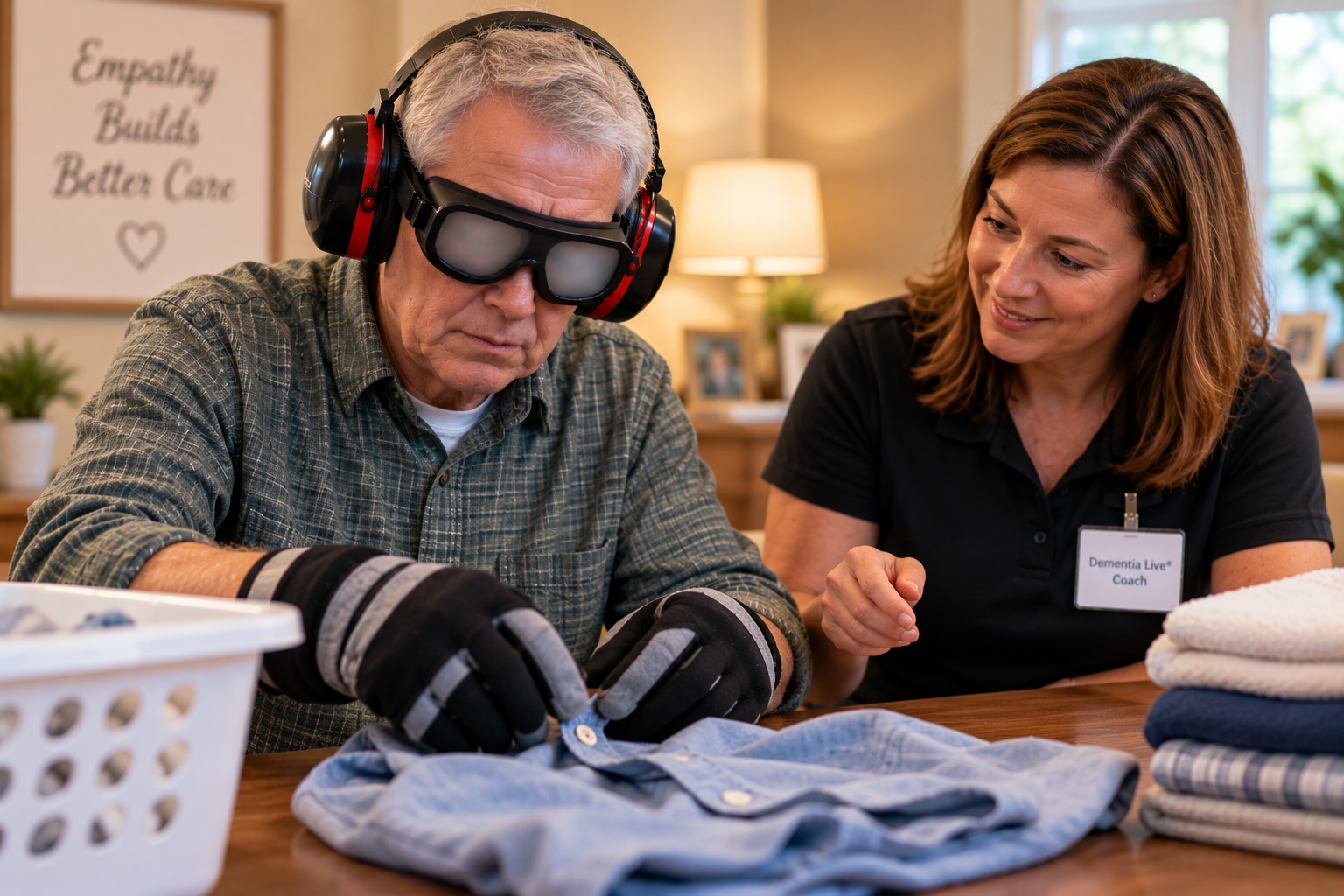
The session is meant to be eye-opening, not frightening. Participants can stop at any time.
What Families Often Notice
People who complete a session often describe feelings like these:
Frustration when simple tasks suddenly take much longer
Anxiety from not being able to see or hear clearly
Embarrassment at needing help, or at "getting it wrong"
Overwhelm when several people talk at once or directions are rushed
Relief when someone speaks slowly, makes eye contact and offers one step at a time
Many families say walking in their loved one's shoes, even briefly, helps them recognize why that person may seem withdrawn, irritable, or "stubborn" when the real problem is confusion: the world has become hard to process.
How the Experience Can Change Daily Life at Home
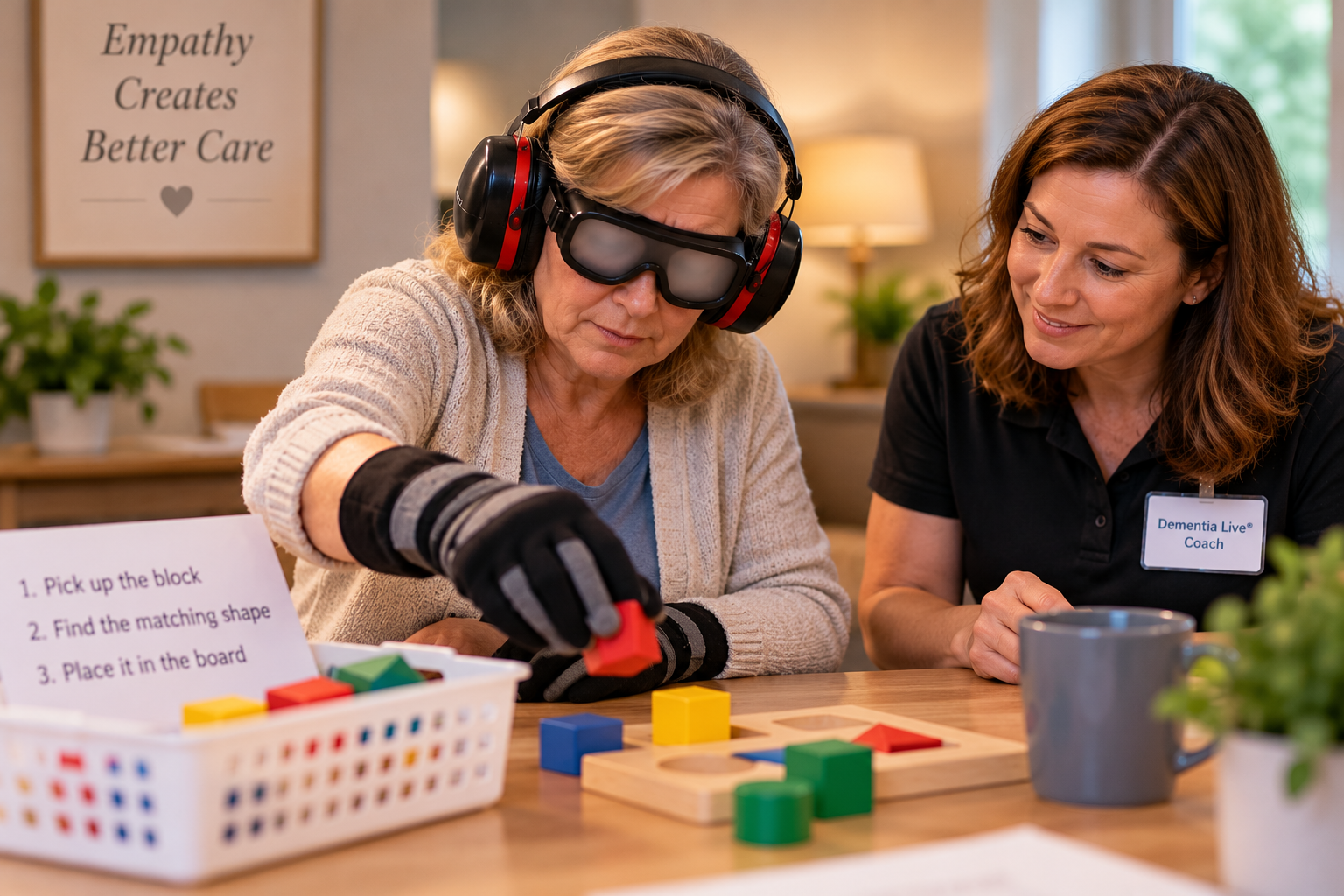
Understanding is the starting point for empathy and more compassionate, person-centered care. Afterward, families often make small changes that can make a big difference at home:
Slow down. Give one direction at a time and wait for a response.
Approach from the front and make eye contact before speaking, especially if sight is limited.
Reduce noise and clutter during meals and conversations.
Offer choices instead of open-ended questions ("Tea or water?" rather than "What would you like?").
Focus on feelings, not mistakes. Reassurance works better than correction.
Check for comfort. Pain, hunger or being too cold can be hard for a person with memory loss to explain.
For more ideas, see our guide to communicating with dementia patients.
Is a Dementia Simulator Right for Your Family?
A session can be helpful for:
Adult children and spouses who are new to being a caregiver
Family members who live farther away and visit less often
Grandchildren and teens who want to understand a grandparent's changes
Anyone feeling frustrated who wants a deeper sense of their loved one's point of view
It isn't a substitute for medical advice from a healthcare provider, and it can't fully recreate what each person goes through. The condition affects everyone differently. Think of it as one helpful window, not the whole picture.
What to Ask Alzheimer's Care Homes About Team Training
If you're comparing Alzheimer's care homes, ask how the team learns to see things from the resident's point of view:
What dementia care education do caregivers receive, and how often?
Has the team taken part in Dementia Live® or a similar empathy-based session?
How does the team respond when a resident is anxious, confused or upset?
How are activities adjusted to each resident's abilities?
Are educational opportunities offered to families?
Clear, specific answers are a good sign that a home takes the person behind the diagnosis seriously.
Braley Care Homes and Dementia Live®
Braley Care Homes is a memory care home in Hurricane, WV, providing Alzheimer's, dementia and memory care since 2008, with a philosophy of "quality care in a home-like environment." Our owner and administrator, Chris Braley, holds a bachelor's and a Master's degree in social work and is a licensed independent clinical social worker (LICSW). Chris received the AGE-u-cate Achievement Award for Dementia Live Coaching.
We provide individualized activities and behavior programming in a home that is locked 24 hours a day, with a secure outdoor courtyard. Families from across the area contact us, including those comparing memory care homes in Charleston, WV.
Frequently Asked Questions (FAQs)
What is the purpose of a session like Dementia Live®?
The goal is empathy: helping caregivers and families understand some of the challenges a person may face, so they can respond with more patience and better support.
How long does a session take?
Sessions are usually short, with the hands-on part often lasting only a few minutes, followed by a group discussion. Length varies by program and coach. [REVIEW R4]
Is it upsetting?
It can feel uncomfortable, and that is part of the learning. A trained coach guides participants, and anyone can stop at any time.
Does it show exactly what living with the condition feels like?
No. It can simulate some common challenges, such as limited vision, distorted sound and reduced touch, but every person's experience is different.
Who leads Dementia Live® sessions?
According to AGE-u-cate, sessions are led by Certified Dementia Live® Coaches trained through its program (AGE-u-cate).
Talk With Us
If you're caring for someone with Alzheimer's or another form of dementia and want to understand your options, start with a free care assessment. It's an easy first step toward support that fits your loved one.
